🙋♂️Hello Aspirants,
If you follow the recent trends of competitive exams, you will clearly notice that questions from National Symbols of India are asked repeatedly in exams like UPSC, SSC, WBCS, NDA, CDS, Railways, Police, and various State PSCs. This topic is part of basic Static GK and verry important for your upcoming exams.
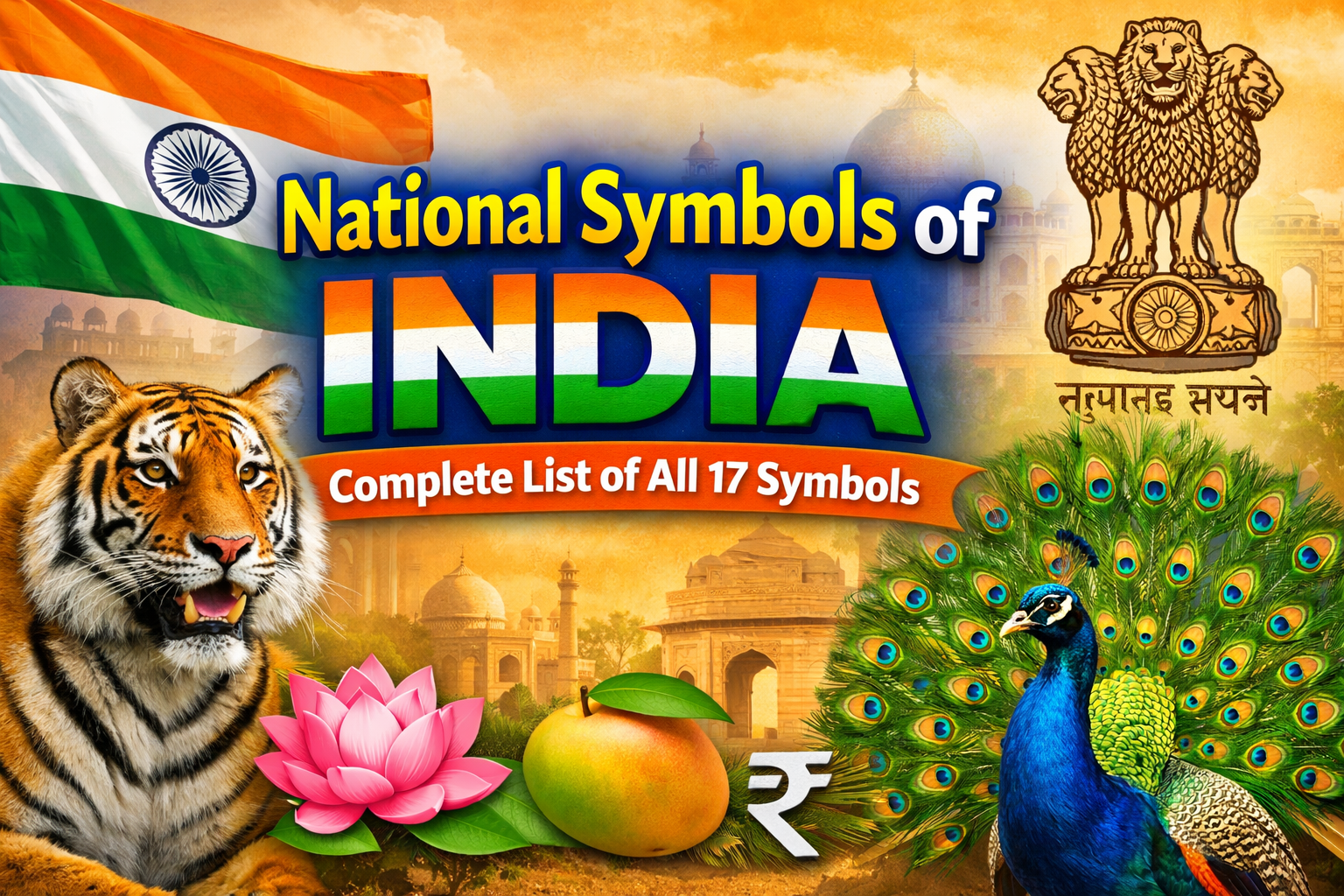
National Symbols of India represent the country’s identity, culture, history, and values. These symbols are frequently asked in competitive exams, either directly or in matching, one-liner, or statement-based questions. To help you prepare this important area in a simple and structured way, ExamYog brings you a complete guide on the National Symbols of India, covering all 17 officially recognized symbols, their features, significance, and exam-relevant facts — all at one blog.

📚 List of National Symbols of India
India officially recognizes 17 National Symbols, each approved by the Government of India.
✒️ 1. National Flag of India (Tiranga)
The National Flag is a horizontal tricolor of Deep Saffron at the top, White in the middle, and Dark-Green at the bottom, with a Navy-Blue Ashoka Chakra at the centre.
✅ Saffron stands for courage and sacrifice.
✅ White stands for peace and truth.
✅ Green stands for growth and prosperity.
✅ Ashoka Chakra has 24 spokes, inspired by the Lion Capital of Ashoka.
✅ The flag is rectangular shape and has a ratio of 3:2.
The flag was adopted on 22 July 1947. Its design is based on the Swaraj flag of the Indian National Congress.
✒️ 2. National Emblem of India
The National Emblem is adapted from the Lion Capital of Ashoka at Sarnath.
✅ Features four Asiatic lions, symbolizing power, courage, pride, and confidence
✅ Only three lions are visible in the emblem
✅ Motto: “Satyameva Jayate” (Truth Alone Triumphs)
The National Emblem of India was adopted on 26 January 1950 by Madhav Sawhney.
✒️ 3. National Anthem – Jana Gana Mana
Written by Rabindranath Tagore in Bengali language, the National Anthem reflects India’s unity and diversity.
✅ It is sung on national occasions and official ceremonies.
✅ Full version duration: 52 seconds
Constituent Assembly adopted Jana Gana Mana's Hindi version on 24 January 1950
✒️ 4. National Song – Vande Mataram
Written by Bankim Chandra Chattopadhyay, it was first published in the novel Anandamath in Bengali language in 1876.
✅ Played a major role during the freedom movement
✅ Adopted as National Song in 1950
In 2005, the Indian government stated that singing "Vande Mataram" is not mandatory but is stimulated to show respect to the country.
✒️ 5. National Calendar (Saka Calendar)
India follows the Saka Calendar along with the Gregorian calendar.
✅ Used in official government documents.
✅ Begins with Chaitra month.
National Calendar (Saka Calendar) was adopted on 22 march, 1957.
✒️ 6. National Animal – Royal Bengal Tiger
The Royal Bengal Tiger symbolises strength, power, and grace.
✅ Found mainly in India and Bangladesh.
✅ Replaced the lion as national animal in 1973.
✅ Closely linked with Project Tiger.
✒️ 7. National Bird – Indian Peacock
The Indian Peacock represents beauty, pride, and elegance.
✅ Known for its colorful feathers.
✅ Declared National Bird in 1963.
✅ Widely found across India.
✒️ 8. National Flower – Lotus
The Lotus symbolises purity, hope, and spiritual enlightenment.
✅ Grows in muddy water but remains clean
✅ Important in Indian culture and religion
✒️ 9. National Tree – Banyan Tree
The Banyan Tree represents longevity and unity.
✅ Known for its large canopy and aerial roots
✅ Symbol of eternal life in Indian tradition
✒️ 10. National Fruit – Mango
Mango is called the King of Fruits.
✅ Represents richness and prosperity
✅ India is the world’s largest producer of mangoes
✒️ 11. National River – Ganga
River Ganga is considered sacred and culturally significant.
✅ Originates from Gangotri Glacier
✅ Longest river in India
✅ Linked with Namami Gange Programme
✒️ 12. National Aquatic Animal – Ganges River Dolphin
Declared National Aquatic Animal in 2009.
✅ Indicator of healthy river ecosystem
✅ Found mainly in the Ganga and Brahmaputra rivers
✒️ 13. National Reptile – King Cobra
The King Cobra is the longest venomous snake in the world.
✅ Symbolizes power and alertness
✅ Found in forests of India
✒️ 14. National Heritage Animal – Indian Elephant
Declared National Heritage Animal in 2010.
✅ Symbol of strength and wisdom
✅ Important in Indian history and culture
✒️ 15. National Script of India – Devanagari Script
Devanagari is the National Script of India, used to write several Indian languages, most importantly Hindi, which is the official language of the Union.
✅ Devanagari is written from left to right.
✅ It is identified by the horizontal line on top, called Shirorekha.
✅ It is used for languages like Hindi, Sanskrit, Marathi, Nepali, and others.
✅ The Indian Rupee symbol (₹) and many government documents use Devanagari elements.
✒️ 16. National Motto – Satyameva Jayate
Meaning: Truth Alone Triumphs.
✅ Taken from Mundaka Upanishad
✅ Written in Devanagari script below the emblem
✒️ 17. National Currency Symbol – Indian Rupee (₹)
The Rupee symbol (₹) was adopted in 2010.
✅ Combines Devanagari “Ra” and Roman “R”
✅ Designed by D. Udaya Kumar.
MCQ Practice – Static GK for Competitive Exams
Strengthen your preparation with carefully designed Static GK practice sets covering National Symbols, Important Days, Polity, History, Geography, and more.
These questions are prepared as per the latest exam trends of UPSC, SSC, WBCS, NDA, CDS, Railways, Police, and State PSC exams.
🔔 Join ExamYog Groups to Stay Regularly Updated
To stay consistently updated, join our Telegram and WhatsApp groups, where you get free PYQs, mock tests, daily current affairs, and study notes. If you want regular guidance and timely updates for your exam preparation, join now and stay ahead with ExamYog – Your Mock Test Partner.
💬 Do You Have Any Suggestions?
ExamYog is built completely for the aspirants, so your valuable feedback and suggestions truly matter to us. If you have any ideas or improvements to share, please click the link below and let us know your thoughts. Your feedback helps us make the platform better for you and everyone.
❓ Frequently Asked Questions (FAQs)
1. Why are National Symbols of India important for competitive exams?
National Symbols are part of static GK, and questions are frequently asked in UPSC, SSC, WBCS, NDA, CDS, Railways, Police, and State PSC exams. They are scoring, direct, and often repeated in prelims.
2. How many National Symbols does India officially have?
India officially recognizes 17 National Symbols, approved by the Government of India, covering areas like culture, wildlife, heritage, and governance.
3. Is Devanagari the national language of India?
No. India has no national language.
However, Hindi written in Devanagari script is the official language of the Union.
4. What is the difference between the National Anthem and the National Song?
- National Anthem: Jana Gana Mana, written by Rabindranath Tagore.
- National Song: Vande Mataram, written by Bankim Chandra Chattopadhyay.
Both have equal respect, but different official status.
5. Which National Symbols are most important for exams?
The most frequently asked symbols include:
- National Flag
- National Emblem
- National Animal (Tiger)
- National Bird (Peacock)
- National Anthem and Motto
6. How many National Symbols does India have?
India officially has 17 National Symbols, approved by the Government of India. These symbols represent India’s culture, heritage, biodiversity, and national identity.
7. What is the National Animal of India?
The Royal Bengal Tiger is the National Animal of India. It symbolises strength, power, and grace and plays an important role in wildlife conservation through Project Tiger.
8. Which is the National Bird of India?
The Indian Peacock is the National Bird of India. It represents beauty, elegance, and pride and is widely found across different regions of the country.
9. What is the National Motto of India?
The National Motto of India is “Satyameva Jayate”, which means “Truth Alone Triumphs”. It is taken from the Mundaka Upanishad and is written below the National Emblem.
10. Where can I practice MCQs from this topic?
You can practice topic-wise and exam-oriented MCQs on ExamYog, designed according to the latest trends of UPSC, SSC, WBCS, NDA, CDS, Railways, and State PSC exams.